
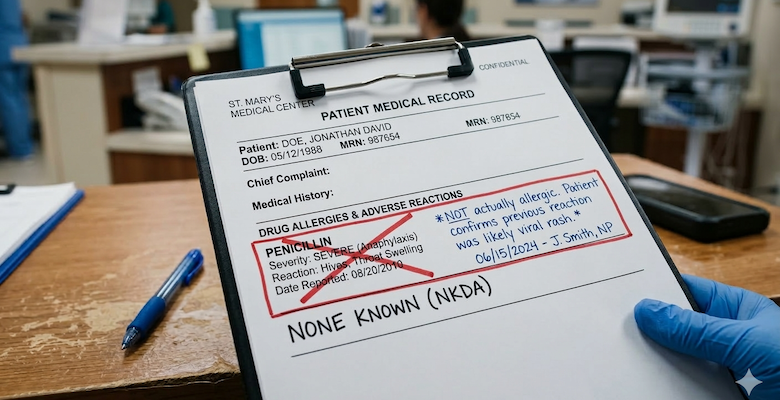
Penicillin is the most commonly listed antibiotic allergy. Penicillin based antibiotics include amoxicillin and amoxicillin-clavulanate (Augmentin), which are the recommended treatments for many of the infections we see in pediatrics including ear infections, pneumonia, strep throat, and sinus infections.
We know that 90% of patients labeled as penicillin allergic are not actually allergic to the drug. Many times, this incorrect allergy labeling happens when kids develop a rash while taking one of these antibiotics, and then ends up in their medical record forever.
Why does an incorrect drug allergy label matter?
If a patient reports being allergic to penicillin, their doctor will need to treat them with an alternative antibiotic. Sometimes, this means we have to use an antibiotic that is less effective at treating the patient’s illness. Alternatively, it could mean we resort to an antibiotic that has broader coverage (ie a stronger antibiotic) than we need. While a stronger antibiotic will still treat the infection, we aim to use just the right amount of treatment, no more or less than what is needed, to treat a condition. Using an antibiotic that is stronger than we need is like amputating a leg for a small cut that just needs stitches. Similarly, an antibiotic that is stronger than necessary opens patients up to more medication side effects and to developing antibiotic resistance in the future.
What does a true penicillin allergy look like?
A true drug allergy falls into the category of what we call an IgE-mediated allergic reaction. This is akin to an allergic reaction to peanuts – it’s an allergy that can lead to anaphylaxis, an emergency. Features of this type of true allergy include:
- Symptoms develop quickly after the medication is administered, usually within the first 24 hours
- Symptoms progress over the course of a short period of time
- Symptoms may include low blood pressure, fainting, difficulty breathing, or immediate swelling
Some other serious drug reactions include serum sickness-like reaction, Stevens-Johnson Syndrome/Toxic Epidermal Necrolysis, and DRESS syndrome. If you were ever diagnosed with any of these reactions, then you should permanently avoid the causative drug.
What rashes are not true allergies and not a reason to avoid the drug?
The two most common rash scenarios that can result in an incorrect allergy label include:
- Amoxicillin drug rash – this is typically a full body rash that develops multiple days into the antibiotic course (often day 7, 8, or 9). The rash can be an impressive rash that looks like small pink/red bumps that can be a little raised or flat. The rash may be a bit itchy, but otherwise the child is typically acting their normal self without other symptoms such as fever, joint swelling, or trouble breathing. This drug rash should be considered a side effect, not an allergy. There is no need to avoid this medication in the future.
- Viral exanthem – this is a harmless rash that is caused by a viral infection; these viral rashes are super common in kids. It is often small pink/red bumps like the amoxicillin rash, but it can also be hives or other types of lesions. These can occur while a patient is on antibiotics because either they get a new viral infection while on the antibiotic, or they have a viral infection at the same time they have an infection requiring antibiotics. Even though the patient is on the antibiotic at the time of the rash, the drug is not the culprit.
What if someone in your family has a history of a drug allergy?
We do not recommend avoiding medications solely based on family history of a drug allergy.
What should you do if you are concerned that your child is having a possible reaction to a medication?
Call us! We will bring you in for a visit to help tease out what is going on and decide if there is concern for a true allergy or not. Please call 911 if it is an emergency.
What should you do if you or your child has been labeled as having a medication allergy but you’re questioning if it is a true allergy?
Call us! Sometimes we will refer to an allergist to help us de-label an allergy, or I often will have a risk/benefit discussion with a family and together make the decision to try that antibiotic again if my suspicion for a true allergy is low.